Although our group did not speak any Latin during our time in Rome,
we did learn to speak some basic Italian. It struck me how similar Spanish and
Italian are – in fact, 82% of vocabulary is similar and the sentence structure
is very alike. Their definite articles are also clearly related:
Spanish: El, la, los, las
Italian: Il, lo, la, l'
These similarities are due to their Latin
root, therefore anyone studying Spanish/ Latin will be more able to understand
basic written and spoken Italian.
Here are some ‘must know’ Italian phrases
if you are planning on visiting Italy:
English
|
Italian
|
Hello/ good morning
|
Buongiorno
|
Good afternoon
|
Buon pomeriggio
|
Good evening
|
Buonasera
|
Excuse me
|
Mi scusi
|
I do not speak much Italian
|
Non parlo molto bene italiano
|
Goodbye
|
Ciao/Arrivederci
|
Yes/ No
|
Si/ no
|
History of Italian:
Standard Italian dates back to the 12th
century however linguists are able to see how Vulgar Latin formed the separate
language in 900AD.
In 1200, we can view this change by looking
at Dante’s epic poetry, known as Commedia. This group of poetry was based on
Virgil’s Aeneid and Cicero’s work; however, he used a distinct language. These
poems were read across Italy and for a long time, his dialect was considered
the ‘canonical standard’ of higher class Italian. Dante was from Florence and
even today, the dialect of Firenze is
the official Italian language.
Italian was influenced greatly by
historical events, for example, the conquest and Italian occupation of Napoleon
helped to spread the language. After this, Italian was known as ‘lingua franca’
which was used as a Latin substitute across much of Europe and the
Mediterranean Sea. Despite this, only 2.5% of the population of Italy spoke the
standardised language in 1861.
The popularity of Italian has been partly
due to its role in music as it is considered the universal language of music
and is written to demonstrate tempo and directions on sheet music. Due to this,
musicians all around the world understand Italian and this may encourage them
to learn more of the language.
The language itself:
Italian is a member of the Romance and
Italic languages and derived diachronically from Latin. However, Italian
contrasts other Romance languages in the way that it retains a difference between
short and long consonants, like Latin.
The Italian alphabet consist of only 21
letters as 〈j, k, w, x, y〉 are not counted
although they exist in loanwords such as ‘weekend’. The letter (h) is generally
silent, especially when at the beginning of a word, i.e. ‘ho’ (I have). The (h)
has been changed to (g) in many cases, for example I pull is ‘traho’ in Latin
but ‘traggo’ in Italian.
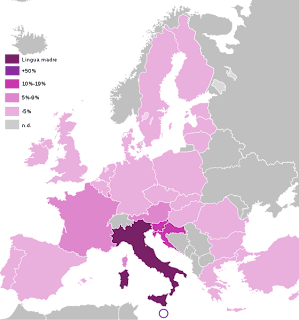
The map below shows the population density
of Italian speakers across Europe. The darkest purple means ‘lingua madre’
which are mother tongue speakers or L1 whereas the other shades show that
Italian is a learned language (L2). This shows that although the vast majority
of native speakers live in Italy itself, quite large proportions of Europeans
learn language as a second language. Italian is still common in Africa and
America due to a high Italian influence and immigration.